Common questions from those who are choosing, buying or just understanding a perfume better.
How to choose a perfume that suits me?
Start with what you like to feel, not just the brand name or the perfume classification. Think of scents that catch your eye, such as citrus, woods, spices, flowers, vanilla, or greener, fresher notes.
It's also worth considering when and where you intend to use the fragrance. Climate, occasion, and your own taste help you arrive at better choices. Knowing the olfactory families and experiencing the scent on your skin makes this process much easier.
What is the difference between Parfum, Eau de Parfum, Eau de Toilette and Eau de Cologne?
These names typically indicate different ranges of fragrance concentration in the formula. Broadly speaking, a Parfum or Extrait tends to be more concentrated, followed by Eau de Parfum, Eau de Toilette, and Eau de Cologne.
But this does not work as a rigid scale. IFRA itself informs that there is no universal definition based only on concentration. In addition, two versions of the same perfume can have different formulas and olfactory proposals. Therefore, Eau de Parfum does not simply mean a stronger Eau de Toilette.
How do you know if a perfume is masculine, feminine or shareable?
Masculine, feminine, and shareable are classifications used by brands to present and position their fragrances. They can help you navigate a collection, but they don't have to limit your choice.
In practice, you can like any perfume regardless of the category in which it was launched. In Homem Perfumado, characteristics such as notes, chords, construction, style, and feel caused by the fragrance are more useful to understand if it makes sense to you.
What are top, heart and base notes of a perfume?
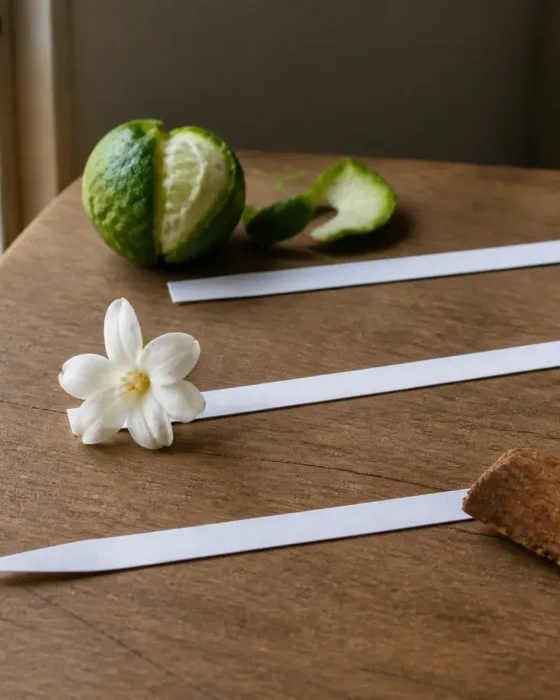
It is a traditional way of explaining how a fragrance evolves over time. The top notes are mainly perceived in the first moments. As they decrease, the heart of the composition gains more space. The base notes usually remain longer and help define the final phase of the perfume.
This division is known as the olfactory pyramid and helps to describe a fragrance, although a perfume is a complete composition and its raw materials can be perceived at different times in evolution.
How long does a perfume last on the skin?
There is no duration that fits all perfumes or all people. Formula, raw materials, amount applied, climate and skin characteristics can greatly change the experience.
Therefore, saying that every Eau de Parfum lasts a certain number of hours or that a higher concentration will always have superior performance is a simplification. The best way to evaluate the duration of a fragrance is to test it on the skin and follow its evolution.
Where to apply perfume for it to work best?
The skin is the main point of application. Wrists, neck and the region behind the ears are among the places traditionally used. Some brands also guide the application on certain pieces of clothing.
There is, however, no mandatory number of sprays or a single correct place to apply. The amount depends on the fragrance, the occasion and the intensity you want. On fabrics, it is prudent to consider the material of the garment before application.
How does Homem Perfumado evaluate and recommend perfumes?
O Homem Perfumado looks at the perfume beyond the list of notes. We analyze its construction, evolution, proposal, context, perceived quality and experience of use, always separating verifiable information from our editorial evaluation.
A recommendation also considers who that fragrance might make sense to, in which situations it works best, and what you can expect from it. Our goal is not to simply tell you whether a perfume is good or bad, but to provide you with information to decide if it deserves a place in your collection.