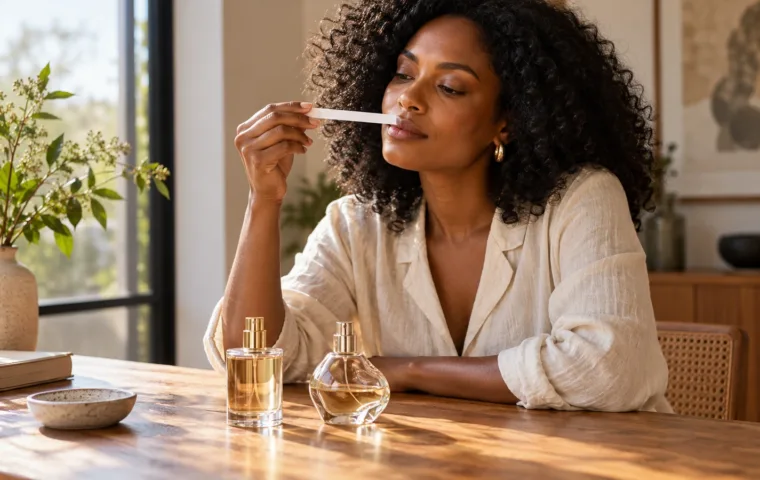

There is a kind of unwritten code of conduct among perfume lovers. Some rules are quite reasonable. Others have gained so much authority over time that almost no one remembers to ask why.
Rubbing your wrists after a spray is among them.
It is an old, intuitive and almost automatic gesture. You apply the perfume, touch one wrist to the other and spread the liquid. Until someone observes the scene with the indignation of someone who has just witnessed a small crime against perfumery.
"Don't rub! You'll ruin the perfume."
The scolding is known. The explanation, not always.
What perfumers say
Francis Kurkdjian has plenty of credentials to participate in this conversation. He created the Le Male, by Jean Paul Gaultier, in 1995, and also the Baccarat Rouge 540, one of the most recognized fragrances in contemporary perfumery.
And he doesn't recommend rubbing your wrists.
In an interview with British Vogue, Kurkdjian explained that friction warms the skin and can interfere with the development of smell. A floral perfume, for example, could lose some of its freshness with this heating.
It is a recommendation that makes sense for those who want to perceive the fragrance from the first moments: spray, let it dry and follow what happens.
But there is a considerable distance between this orientation and the idea that two rubbed wrists are capable of ruining a perfume.
What really happens to the fragrance?
Perfume is not a photograph. It is a composition that changes while it is on the skin.
Those first impressions, often fresher and more volatile, do not remain exactly the same over the hours. Other aspects of the fragrance are gaining space. Sometimes, a perfume that seemed luminous at the exit later reveals a warmer, woody or sweeter facet.
This transformation is part of the experience.
A study published in International Journal of Cosmetic Science investigated how the characteristics of molecules and skin influence the evaporation of fragrances. It is an important contribution to understanding this behavior, but not an experiment on rubbing the wrists.
Therefore, to say that friction reduces fixation by two, three or four hours would be to go beyond what this research allows us to conclude.
Kurkdjian's recommendation concerns the development of the smell. The story that rubbing your wrists simply destroys the fragrance is a much more dramatic version.
And the skin, does it come into this story?
Come in. And perhaps it is the least remembered part of this discussion.
Dermatologist Ingrid Campos, heard by the iG in a report on the subject, notes that vigorous friction can lead to irritation, especially on sensitive skin.
It is no reason to treat any contact between the wrists as a danger. But there is also no great reason to insistently rub an area that has just received perfume.
If there is burning, itching or redness, it is worth discontinuing use in that area and seeking medical advice if the reaction persists.
The best argument for leaving your wrists alone
Anyone who likes perfume knows how a spray can yield a different experience at every moment. The freshness that appears first, a facet that appears later, that detail that we only notice when we feel the fragrance again.
That is precisely why it is worth trying to let the perfume dry naturally. It costs nothing, does not require any special technique and allows you to follow the smell from the first moments, without adding friction to the application.
And it is not only Francis Kurkdjian who recommends this care.
Junior Barreiros, one of the main Brazilian references in content about perfumes and responsible for the third largest perfumery channel in the world, also advises not to rub the region after spraying. In the video below, he demonstrates this and other precautions with the use and conservation of fragrances.
At the end of the day, we don't have to treat a scrub like a disaster. But when the likes of Francis Kurkdjian and Junior Barreiros recommend letting your perfume dry naturally, there's good reason to pay attention.
We, around here, prefer to follow the advice. After all, if the idea is to take advantage of every detail of a fragrance, why not start with the way to apply it?