
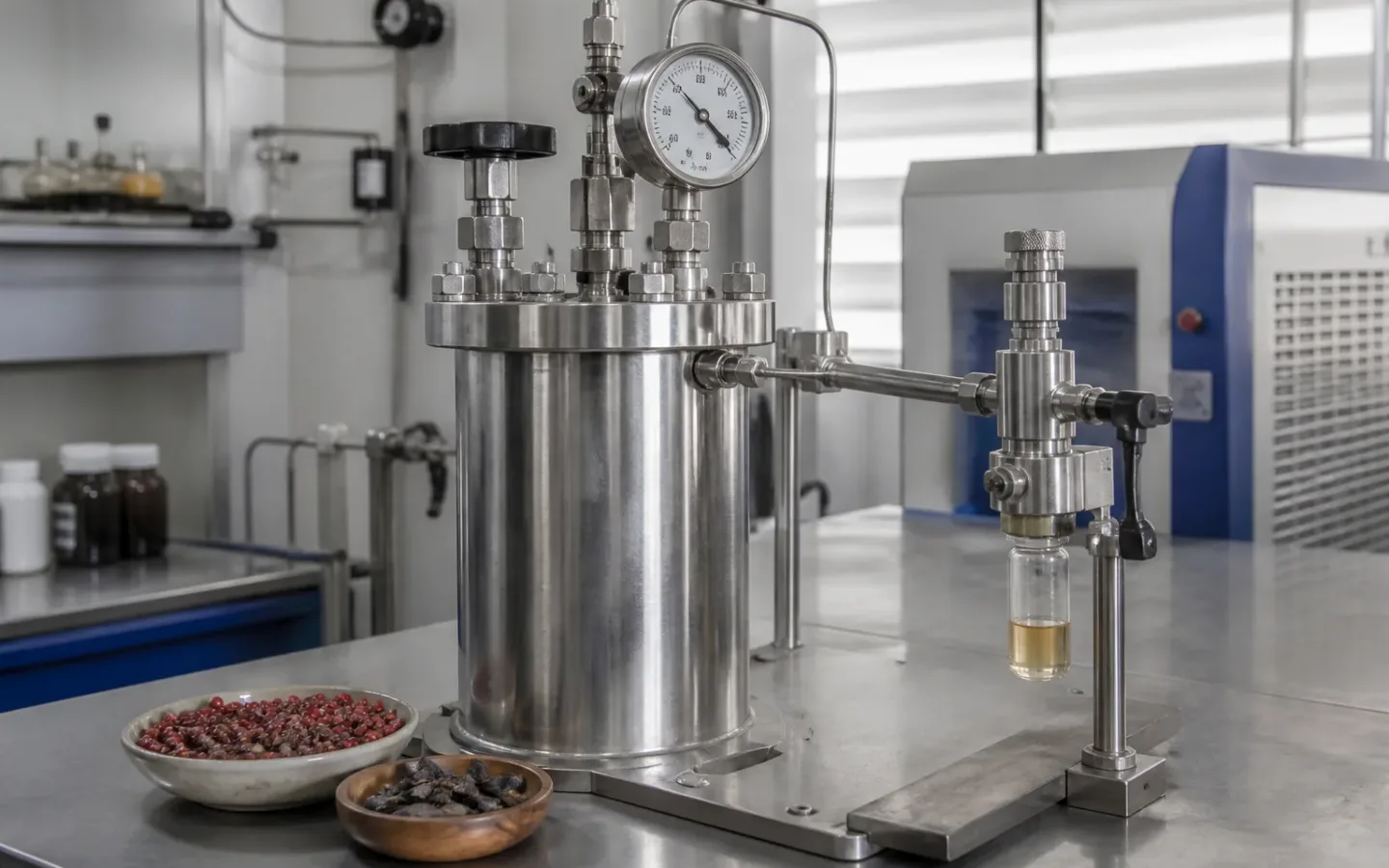
The same carbon dioxide known as a gas can, under specific pressure and temperature, enter a state that does not behave exactly like a gas or a liquid. At this supercritical point, it penetrates the plant material and dissolves certain aromatic compounds.
Then, the pressure decreases. The CO₂ returns to the gaseous form and separates from the extract.
A solvent that leaves the scene
The great technical advantage is precisely this change of state. CO₂ can be recovered and reused in closed systems, while the extract is left without residue of carbon dioxide itself under normal conditions.
The process also works at relatively low temperatures, which is interesting for heat-sensitive components. For this reason, CO₂ extracts are often described as being close to the parent material in certain facets.
But "more faithful" is not a universal rule. Pressure, temperature and time define which components will be extracted. Adjusting these parameters changes the result.
Not the same as essential oil
Distilled essential oil brings together what traveled with the steam and resisted the process. CO₂ extract can carry less volatile components and have a different body. Two versions of the same vegetable may seem like relatives with their own personalities.
Vanilla, pink pepper and tonka bean are among the materials cited by the IFF in specific applications of this method.
Clean technology does not mean zero impact
Supercritical CO₂ is usually presented as an environmentally interesting alternative, especially due to the solvent recovery and process conditions. Even so, high-pressure equipment requires energy, investment, and control.
Sustainability needs to consider plant origin, yield, energy, scale, and material destination—not just the name of the technology.
How to turn information into choice
If a brand highlights "CO₂ extract", try to find out which raw material and with which olfactory purpose. The expression alone does not guarantee superior quality.
When possible, compare a CO₂ extract and an essential oil from the same vegetable in strips, always already prepared for safe evaluation. Look for density, freshness, and less volatile veneers. The process appears in smell, but rarely as a simple answer.