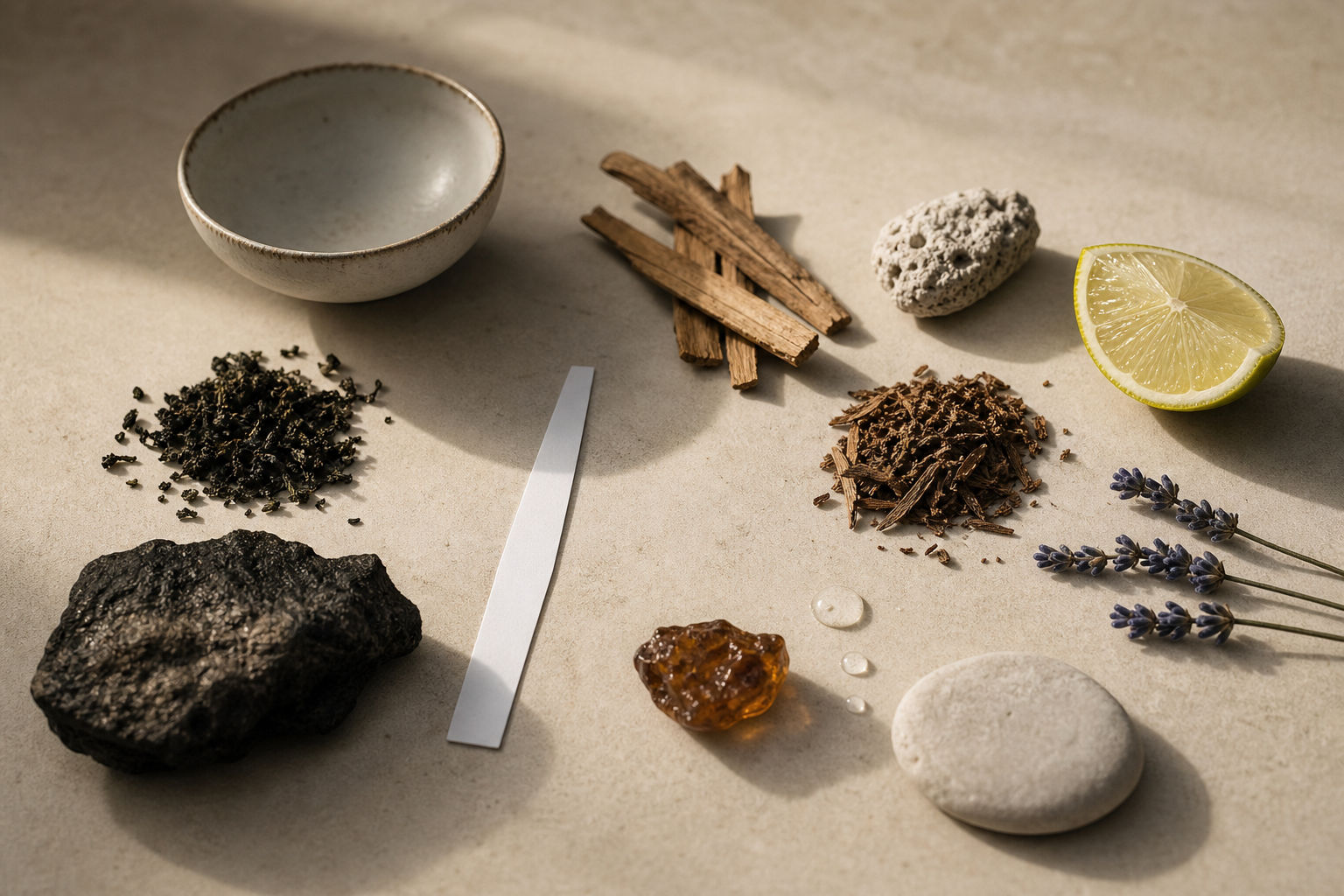

You smell the perfume clearly. When you try to explain, it only appears "smelly".
This does not prove a lack of smell. Naming odors is difficult, even for people with experience in sensory areas. In many languages, we turn to the source: it smells like lemon, wood, makeup, rain.
This strategy is not poor. It is the beginning of a vivid description.
Don't start with the pyramid
If you read "rose, oud, and saffron" before you feel it, you run the risk of writing a version of the list. Close the page and answer first:
Does the perfume come close to or occupy the room? Is it light or dark? Dry or wet? Smooth or rough? Familiar or strange?
!Simple scales of light, dark, dry, wet, near and expansive
These pairs are not objective measures. They function as coordinates to organize the experience.
Give the smell a scene
"Woody" informs one family. "Wood warmed by the sun" informs temperature, atmosphere and memory.
Look for a concrete scene, but don't force poetry. If you remember a doctor's office, say a doctor's office. If it looks like orange peel on a bar table, this image can explain more than four technical adjectives.
Then, ask which element caused the association. Cleanliness? Metal? Alcohol? Bitter bark? Thus, memory becomes analysis.
Tell us what has changed
A still description loses half of its scent. Use verbs.
It opened brightly. It dried up. It warmed up. It became sweeter. The smoke appeared. The flower receded.
Verbs show evolution and make the text easy to hear. They also avoid a pile of unrelated notes.
Differentiate perception, memory, and judgment
"Reminds you of talcum powder" is an association. "Powdered" is descriptor. "I found it comfortable" is evaluation. The three sentences are valid, but they say different things.
Separating them makes the description more honest. Another person may recognize the talc and feel no comfort.
A formula that doesn't look like a formula
If it gets stuck, answer in order:
How does it arrive?
What place or object do you remember?
How does it change?
How does it make you feel?
Technical vocabulary will come with reading and comparing. You don't have to expel your language to get in. Perfume is abstract; good words don't trap smell. They leave a door open for someone else to find you.