The perfume is still on your wrist, but you don't feel anything anymore. Then another person enters the room and asks what is so fragrant.
This mismatch is a good demonstration of olfactory adaptation. With continuous or repeated exposure, the perceived intensity may decrease. The olfactory system stops treating that stimulus as a novelty.
It's not the nose "breaking". It's a normal response.
Fatigue doesn't just appear in disappearance
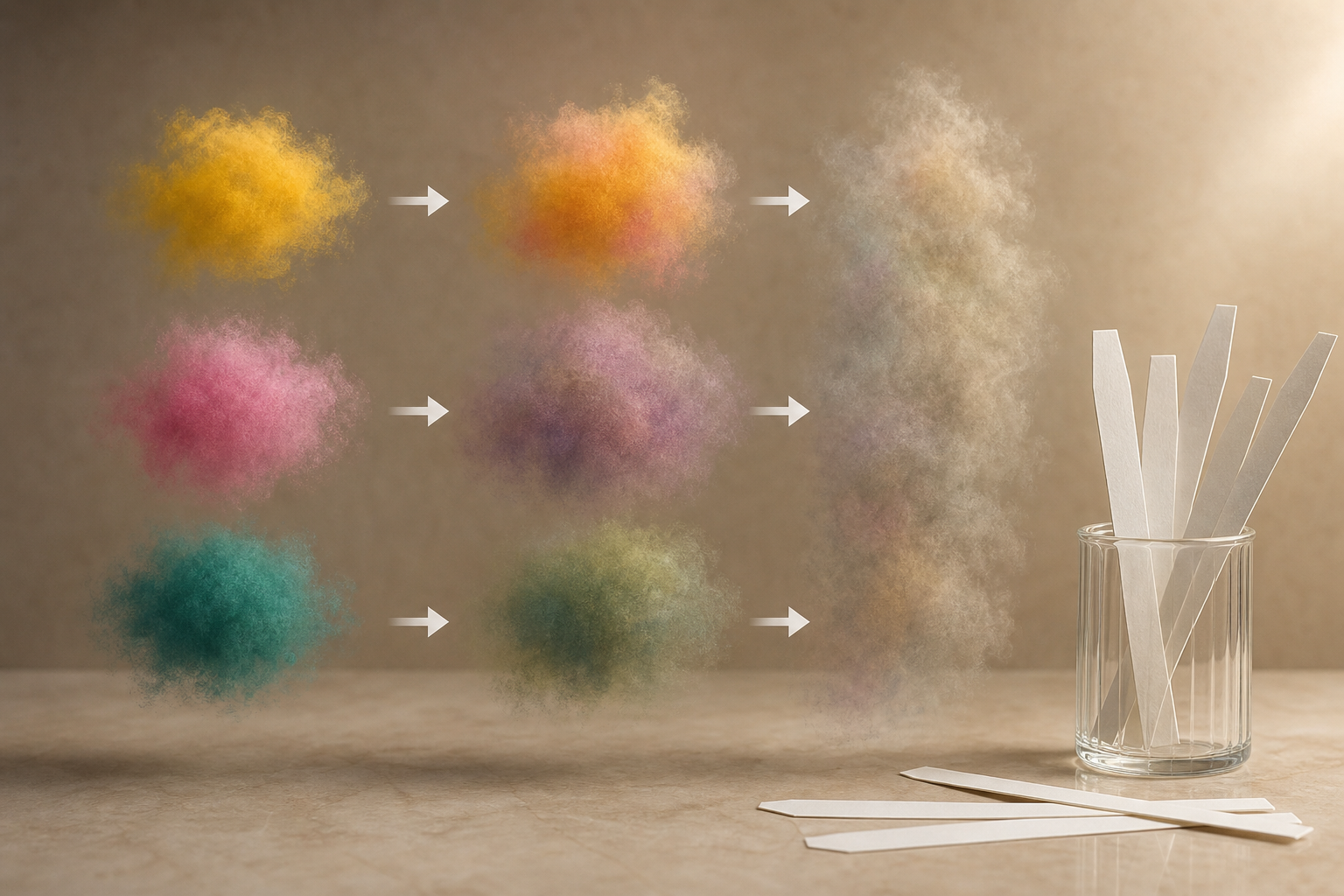
Sometimes the perfume does not disappear. It loses relief. Three ribbons begin to share the same smell, nuances become difficult to separate and the desire to bring the paper closer and closer increases.
This is the time to step back.
!Three once-distinct tapes becoming jumbled after repeated sniffs
Sniffing harder rarely returns accuracy. It can increase exposure and speed up confusion.
Less perfume, more information
Limit the number of candidates. Keep the tapes away from your face between evaluations. Take brief inspirations and avoid leaving the environment full of spray.
Grouping by objective also helps. Compare three citrus or three woody, but don't try to evaluate the entire store in a single round. If the fragrances are too potent, reduce it further.
Unscented air is the best interval. Leave the testing area, walk around, and let your attention rest. Water can help with comfort, although it doesn't work as a smell reset button.
Your own scent can also fade
Using the same fragrance for hours reduces attention to it. This can lead to excessive reapplication. Before spraying again, ask someone you trust if the presence is still noticeable, or move away from the garment and come back later.
Applying too close to the face, such as on the neck, maintains constant exposure. To assess more clearly, the forearm offers distance and allows voluntary returns.
When to Wrap Up
If you can no longer distinguish basic contrasts, feel uncomfortable, or start completing the experience from the note list, stop. Resuming the next day does not invalidate the session.
It is worth an additional precaution: persistent loss, sudden change or perception of non-existent smells should not be treated as simple perfumery fatigue. The NIDCD recommends medical evaluation for changes in smell.
Training the nose is also learning to listen when it no longer has anything useful to add at that moment.