
When someone talks about incense, the memory usually comes before the explanation. It can be a church, a temple, or that stick burning at home. These memories help, but they only show part of the story.
In perfumery, incense can indicate an aromatic resin, an oil extracted from that resin, or an accord built to resemble smoke, ash, and balsamic heat. It's a broad word, and it explains why incense perfumes can smell so different.
Before the smoke there is the resin
One of the most important references is frankincense, also called frankincense. It comes from trees of the genus Boswellia. Small incisions allow the resin to exit the trunk, come into contact with air, and harden before collection.
For centuries, this resin was important enough to move long trade routes. UNESCO describes a network of more than two thousand kilometers that carried frankincense and myrrh from the south of the Arabian Peninsula towards the Mediterranean. Cities, fortresses and stopping points grew along this path.
When we feel frankincense today, therefore, we are not just facing a contemplative note. We are close to a matter that already crossed deserts, ports and cultures long before the modern bottle existed.
Here appears a curiosity that changes the way you feel this note: the resin without burning does not smell like smoke. It can bring citrus, green, balsamic and pine-like facets.
When it is burned, ash, charcoal, and toasted material appear. A perfume can exploit light resin, dark smoke, or both at the same time.
Frankincense can be almost luminous
Religious association often leads us to imagine something dense and solemn. But a distilled frankincense oil can look fresh, dry, and even shiny.
With bergamot, its citrus facet gains space. Pepper and cardamom increase dryness. Woods bring a contemporary feel. With amber and vanilla, the composition is warmer and more balsamic. Patchouli and vetiver pull earth, wood and smoke.
Flowers also work well with incense. The contrast between a light flower and a resinous background creates depth without the scent necessarily weighing it down.
The path from the resin to the bottle
Resin is the material that hardens after it leaves the tree. Distillation produces an essential oil that captures some of its volatile components. Other extractions and fractionations offer different results.
Construction can also use natural and synthetic materials to create an incense accord. This is how a composition can suggest cold stone, embers, church, burnt wood or clean smoke without relying on a single matter.
Therefore, finding "incense" in the description does not automatically allow us to say that there is natural frankincense in the bottle. The word has a direction of smell.
A simple way to separate resin and smoke
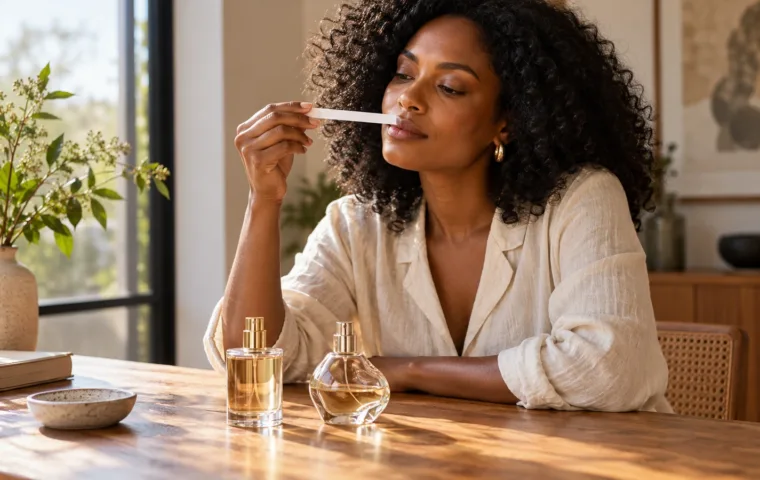
If you have access to frankincense grains of known origin, feel it first without burning. Look for dried lemon, pine, wood, and balsam. On another occasion, with proper ventilation and support, observe what changes during the burn.
In perfumes, ask similar questions. Is there a citrus light before the smoke? Does the effect look like pine resin or ash? Is the smoke hot, like a campfire, or cold, like an extinguished ember? Is there a mineral, almost stone-like sensation?
Those who are starting out can use simple words such as light, dark, fresh and hot. Those who already know raw materials can observe terpenic, balsamic, phenolic and mineral sides. The important thing is that the vocabulary helps to perceive, not complicate.
Not all resin is frankincense
Myrrh and opoponax are also resins used in perfumery, but they have their own profiles. A generic description of incense can hide different creative choices.
This distinction helps the reader better interpret the pyramid. Instead of imagining a single smoke, it is worth thinking of a territory that goes from fresh resin to charcoal.
When you find incense in a description, try to figure out which side the perfume chose: fresh resin, dry wood, stone, smoke, or balsamic heat. This question turns a vague word into a tool of choice and makes seemingly similar fragrances go their separate ways.