"Toilette" sounds like toilet to those who translate it literally. In the name Eau de Toilette, however, the word comes from the historical idea of personal care and preparation. Today, EDT identifies a type of fragrance presentation.
A band, not a universal regulation
Technical references usually place Eau de Toilette below Eau de Parfum and above Eau de Cologne in aromatic concentration. Ranges such as 5% to 15% appear frequently.
This is not a mandatory international border. Brands work with their own criteria, and the percentage alone does not count the formula.
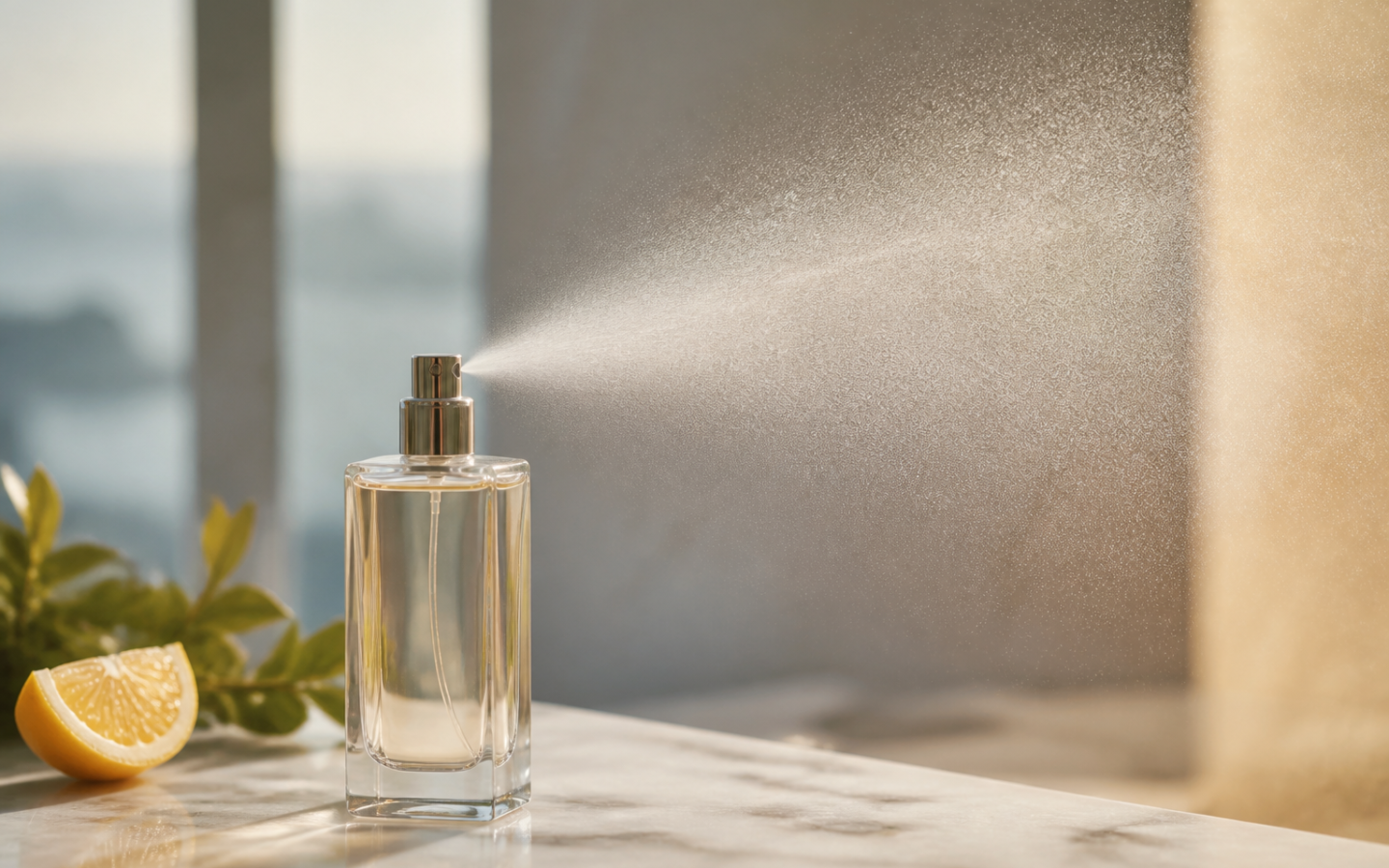
!Clear mist of Eau de Toilette spreading in the air
Light doesn't mean weak
An EDT can be expansive, especially at aperture. More alcohol and volatile materials can create a luminous output. Some are inconspicuous afterward; others remain for many hours.
The composition decides. A woody EDT can last longer than an EDP based on very volatile notes. Quantity applied, environment and adaptation also change perception.
The same fragrance may not be the same
When a line offers EDT and EDP, it's tempting to imagine the same recipe in different doses. There's often creative reformulation: EDT highlights citrus and herbs; EDP can deepen flowers, spices, or base.
Compare as relative perfumes, not as diluted copies.
For whom it makes sense
Eau de Toilette can please those who like lively outings, reapplication and a less dense presence. But the name does not define season, gender or occasion.
Before you choose, swap out "EDT is short-lived?" for two better questions: How does this formula evolve, and how much of that presence do I want during the day?